Duration
12 Days
Max Altitude
4,130 meters
Difficulty
Moderate
Group Size
Min 2 people
Trek Region
Annapurna
Best Season
Mar-Apr / Oct-Nov
ANNAPURNA BASE CAMP TREK
This Annapurna base camp trek offers an amazing taste of Himalayan trekking in Nepal. It is a moderate trek full of adventures, scenery and experiences. It offers breath taking views of Annapurna massif, its glaciers, landscapes, vegetation and rich bio diversity. Besides that, the trail passes through various settlements and villages of Gurung and Magar. They have their own culture and tradition which will be a new thing to see and experience. They have their own unique lifestyle. The trail goes along the Modi Khola inside the dense forest of lush rhododendron trees, bamboo and alpine trees.
The best time for this trek is during the spring season (March-May) and autumn (Oct-Dec). A large number of trekkers include this trek in their holidays for an exciting adventure and experience in the Himalayas of Nepal. It will be an unforgettable memory walking up to the base camp gathering memories and experiences in the Himalayas. The trek doesn’t require an advanced physical fitness level. It can also be included in family vacation and holidays with kids. We strongly believe it will not be as hard as you think up to the base camp. We have good experience trek guide who are familiar with kids as well. A family trip like this would be a beautiful and astonishing memory admiring the Himalayas from the Annapurna base camp, 4130m.
Highlights of Annapurna Base Camp Trek
- Annapurna Base Camp: The trek's ultimate destination, offering breathtaking panoramic views of the Annapurna massif, including Annapurna I, Annapurna South, Machapuchare (Fishtail), and Hiunchuli.
- Scenic Landscapes: Diverse scenery ranging from lush rhododendron forests and terraced fields to alpine meadows and high-altitude desert landscapes.
- Mountain Views: Spectacular views of the Annapurna and Dhaulagiri ranges, especially from the high-altitude vantage points.
- Ghorepani Poon Hill: Optional detour for sunrise views over the Annapurna and Dhaulagiri ranges, providing an early highlight of the trek.
- Traditional Villages: Experience local culture and hospitality in picturesque Gurung and Magar villages like Tikhedhunga, Ghorepani, and Chomrong.
- Varied Ecosystems: Traverse through different ecosystems, from subtropical forests to alpine and high-altitude landscapes.
- Sunrise and Sunset Views: Enjoy stunning sunrise and sunset views over the mountains, particularly from ABC and Poon Hill.
- Unique Flora and Fauna: Encounter diverse flora and fauna, including rhododendron forests, bamboo groves, and potentially glimpses of wildlife like the Himalayan tahr.
- Warm Tea Houses: Stay in cozy tea houses along the trail, providing comfort and an opportunity to interact with fellow trekkers.
- Cultural Insights: Gain insights into the local culture and traditions of the mountain communities in the Annapurna region.
Outline Itinerary
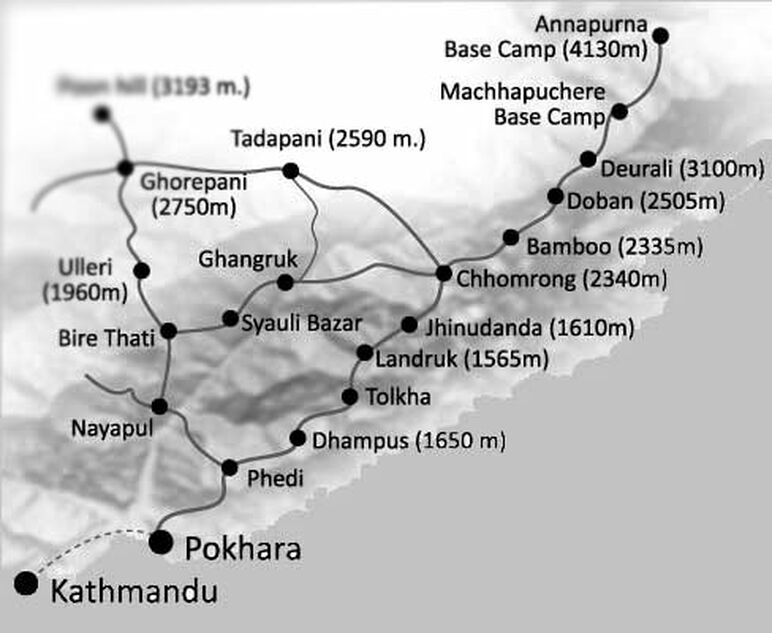
Day 01: Drive from Kathmandu to Pokhara (845m),6-7 hours’ drive,204 km
Day 02: Drive to Ulleri (2,070 m) from Pokhara, 4 to 5 hours drive.
Day 03: Trek to Ghorepani (2,840 m) from Ulleri - 6 to 7 hours trek.
Day 04: Ghorepani - Poon hill (3210 m.) - Tadapani (2540 m), 5 to 6 hours trek
Day 05: Trek to Chhomrong (2,170 meters) from Tadapani – 5 to 6 hours trek
Day 06: Trek to Bamboo (2,310 meters) from Chhomrong – 4 to 5 hours trek
Day 07: Trek to Deurali (3,230 meters) from Bamboo – 5 to 6 hours trek
Day 08: Trek to Annapurna Base Camp (4,130 meters) from Deurali via Machapuchare Base Camp (3,700 meters) and back to MBC – 6 to 7 hours trek
Day 09: Trek to Dovan (2,500 meters) from MBC – 6 to 7 hours trek
Day 10: Trek to Chhomrong (2,170 meters) from Dovan – 6 to 7 hours trek
Day 11: Trek to Jhinu Danda (1,780 meters) from Chhomrong and Drive back to Pokhara (820 meters) – 4 to 5 Hours trek + 1.5 hours drive
Day 12: Drive back to Kathmandu
Day 01: Drive from Kathmandu to Pokhara (845m),6-7 hours’ drive,204 km
Begin your journey with a scenic drive from Kathmandu to Pokhara, covering a distance of 204 km in approximately 6-7 hours. Upon arrival, check into your hotel and explore the lakeside area in the evening.
Day 02: Drive to Ulleri (2,070 m) from Pokhara, 4 to 5 hours drive.
You'll start your adventure with a 4-5 hour drive to Ulleri. The journey takes you through beautiful landscapes, passing by terraced fields, quaint villages, and dense forests. By late afternoon, you’ll arrive in Ulleri, a charming village perched at an altitude of 2,070 meters. Here, you'll spend the evening acclimatizing and soaking in the peaceful atmosphere, preparing yourself for the trek ahead.
Day 03: Trek to Ghorepani (2,840 m) from Ulleri - 6 to 7 hours trek.
Your trek officially begins as you leave Ulleri behind and head towards Ghorepani, located at 2,850 meters. This day’s trek is a steady uphill climb, with the trail winding through dense rhododendron forests that burst into a riot of colors during the blooming season. Along the way, you'll pass through small villages where you can catch a glimpse of the local culture and way of life. The trek, which takes around 6-7 hours, can be challenging, but the stunning mountain vistas and the peaceful forest trails make it worthwhile. Ghorepani, your destination for the day, is a charming village with breathtaking views of the surrounding mountains.
Day 04: Ghorepani - Poon hill (3210 m.) - Tadapani (2540 m), 5 to 6 hours trek
Today after early breakfast you will start your hike to Poon Hill (3210m) for hour in order to witness best majestic scenery and sunrise over the high mountains. A lot of majestic mountains can be seen from Poonhill including the mountains likes of Dhaulagiri (8167m), Annapurna South (7119m), Fishtail (6993m), Nilgiri south, Singa chuli, Annapurna I (8091m). You then come down to Ghorepani to have breakfast and trek to Tadapani for 5 to 6 hours. Trek leads mainly up and down hill through the forest.
Day 05: Trek to Chhomrong (2,170 meters) from Tadapani – 5 to 6 hours trek
Leaving Tadapani, you’ll descend through a dense forest, with the sounds of chirping birds and rustling leaves accompanying you. The trail eventually opens up to reveal the stone steps that lead to Chhomrong, a large Gurung village situated at 2,170 meters. The 5-6 hour trek is a mix of descents and ascents, offering both challenges and rewards in the form of beautiful landscapes and glimpses of local life. Chhomrong is strategically located on a ridge with unobstructed views of Annapurna South and Machapuchare, making it a popular stop for trekkers. The village’s vibrant atmosphere and cozy teahouses provide a perfect end to the day.
Day 06: Trek to Bamboo (2,310 meters) from Chhomrong – 4 to 5 hours trek
The trek from Chhomrong to Bamboo is a shorter day, taking about 4-5 hours. The day begins with a descent to the Chhomrong Khola, followed by a steep climb through a forest rich with bamboo, rhododendron, and oak trees. The trail is well-maintained, and the surrounding greenery creates a peaceful ambiance. As you approach Bamboo, at 2,310 meters, the landscape becomes more enclosed, with the dense forest providing a sense of seclusion. Bamboo is a small settlement, and its name reflects the predominant plant species in the area. The quiet and tranquil surroundings make it an ideal place to rest and recharge for the days ahead.
Day 07: Trek to Deurali (3,230 meters) from Bamboo – 5 to 6 hours trek
The trail from Bamboo to Deurali continues through dense forests, gradually ascending as you make your way towards higher altitudes. This day’s trek is about 5-6 hours, with the path becoming steeper and rockier as you approach Deurali. Along the way, you'll pass the Hinku Cave, a significant landmark where trekkers often take a short break. The landscape starts to change as you climb higher, with the forest giving way to more open terrain and scattered boulders. Deurali, at 3,230 meters (10,597 feet), offers a sense of entering the heart of the mountains, with towering peaks surrounding the small settlement.
Day 08: Trek to Annapurna Base Camp (4,130 meters) from Deurali via Machapuchare Base Camp (3,700 meters) and back to MBC – 6 to 7 hours trek
This is one of the most exhilarating days of the trek, as you make your way from Deurali to Annapurna Base Camp (ABC), with a stop at Machapuchare Base Camp (MBC) along the way. The trek begins with a gradual climb to MBC, situated at 3,700 meters. The trail opens up into the Annapurna Sanctuary, a natural amphitheater surrounded by towering peaks. From MBC, you continue to ABC, at 4,130 meters, where the majestic south face of Annapurna I dominates the skyline. The sense of achievement upon reaching ABC is immense, and the panoramic views are nothing short of spectacular. After spending some time at ABC, you'll return to MBC for the night, allowing for better acclimatization.
Day 09: Trek to Dovan (2,500 meters) from MBC – 6 to 7 hours trek
After the high-altitude experience of ABC, you’ll begin your descent, retracing your steps back through MBC and Deurali before continuing down to Dovan. The descent is long, taking about 6-7 hours, but the downhill trek is less strenuous. As you descend, the landscape gradually shifts from the rocky, high-altitude terrain back to the lush forests. Dovan, at 2,500 meters (8,202 feet), is a small, quiet spot nestled in the forest, providing a peaceful place to rest after a long day of trekking.
Day 10: Trek to Chhomrong (2,170 meters) from Dovan – 6 to 7 hours trek
The trek from Dovan to Chhomrong involves both descents and ascents, making it a moderately challenging day. You’ll pass through Bamboo once again before tackling the steep climb back to Chhomrong. The 6-7 hour trek is a mix of familiar trails and new perspectives, as you retrace your steps but see the landscape from a different angle. Returning to Chhomrong, with its welcoming atmosphere and stunning views of the Annapurna range, feels like coming full circle, offering a sense of completion and satisfaction.
Day 11: Trek to Jhinu Danda (1,780 meters) from Chhomrong and Drive back to Pokhara (820 meters) – 4 to 5 Hours trek + 1.5 hours drive
On your final day of trekking, you’ll descend from Chhomrong to Jhinu Danda, a village renowned for its natural hot springs. The 4-5 hour trek is relatively short, giving you plenty of time to relax in the soothing hot springs, a perfect way to ease any lingering soreness from the trek. Afterward, you’ll continue descending to Nayapul, where a private vehicle will be waiting to take you back to Pokhara. The 1.5-hour drive marks the end of your trekking adventure, as you return to the comforts of Pokhara, where you can celebrate the completion of a memorable journey through the Annapurna region.
Day 12: Drive back to Kathmandu
A scenic drive from Pokhara to Kathmandu will take 7hrs or in optional you will fly from Pokhara to Kathmandu. At Kathmandu, you will have free time for shopping souvenirs for family and friends, overnight at the hotel.

- Full board meals throughout the trek, including breakfast, lunch, and dinner, along with tea/coffee.
- Accommodation in the best available twin-sharing lodges during the trek.
- Private Vehicle/Scorpio from Kathmandu to Pokhara,
- Private Vehicle from Pokhara to Ulleri and from Nayapul to Pokhara
- An experienced English-speaking trekking guide and a porter to carry luggage. The porter ratio is 1 porter for every 2 trekkers.
- The guide and porter's salaries, insurance, equipment, and meals are all included.
- A comprehensive medical kit for any necessary medical assistance during the trek.
- Handling of all necessary paperwork and permits, including the Annapurna Conservation Area Permit (ACAP) and others. Please bring three passport-sized photographs.
- All applicable government and local taxes.
- Accommodation and meals in Pokhara & Kathmandu
- Travel Insurance
- International airfare
- Nepal entry visa fees
- All kinds of cold drinks, including water, coke, Fanta, juice, etc.
- Wi-Fi internet during the trek
- Personal trekking equipment
- Tips for tour guides, trekking staff, drivers, etc.
- Best Time to Trek:
- Spring (March to May): Offers stable weather, clear skies, and moderate temperatures.
- Autumn (September to November): Generally clear with pleasant temperatures, ideal for trekking.
- Winter (December to February): Cold temperatures and potential snowfall, but fewer trekkers.
- Monsoon (June to August): Heavy rain and leeches, not recommended for trekking.
- Permits Required:
- TIMS Card: Trekkers’ Information Management System card.
- Annapurna Conservation Area Permit (ACAP): Required for entry into the Annapurna region.
- Accommodation:
- Tea houses and lodges are available along the trek, offering basic amenities with varying levels of comfort.
- Difficulty:
- Moderate trek with a mix of terrain, including some steep ascents and descents. Suitable for trekkers with a good level of fitness.
- Altitude:
- Reaches a maximum of 4,130 meters (13,550 feet) at Annapurna Base Camp.
Packing List for Annapurna Base Camp Trek
Essentials:
- Backpack: 50-60 liters with rain cover.
- Sleeping Bag: Rated to at least -15°C (5°F).
- Trekking Poles: For stability on uneven and sometimes steep trails.
- Water Bottle/Hydration System: At least 2 liters capacity.
- Water Purification: Tablets or filter.
Clothing:
- Base Layers: Moisture-wicking thermal tops and bottoms.
- Mid Layers: Fleece or lightweight down jacket.
- Insulating Layers: Warm down jacket or heavy fleece.
- Outer Layers: Waterproof and windproof jacket and pants.
- Trekking Pants: Quick-dry and comfortable.
- Hiking Shirts: Lightweight and breathable.
- Warm Hat: For cold weather.
- Sun Hat: For sun protection.
- Gloves: Warm and waterproof.
- Socks: Moisture-wicking and thermal (several pairs).
- Gaiters: To keep debris and snow out of your boots.
Footwear:
- Trekking Boots: Waterproof and well-broken-in.
- Camp Shoes: Lightweight sandals or sneakers.
Accessories:
- Sunglasses: UV protection for high-altitude sun exposure.
- Sunblock: High SPF for face and lips.
- Personal First Aid Kit: Include blister treatment, pain relievers, and altitude sickness medication.
- Headlamp: With extra batteries.
- Camera: To capture the stunning scenery.
- Binoculars: Optional, for wildlife and panoramic views.
Documents:
- Passport: With necessary visas.
- TIMS Card: Trekkers’ Information Management System card.
- Permit: Annapurna Conservation Area Permit.
Food and Hydration:
- Snacks: Energy bars, nuts, and dried fruits.
- Electrolyte Tablets: To stay hydrated and replenish lost salts.
Miscellaneous:
- Travel Insurance: Covering high-altitude trekking.
- Personal Hygiene Items: Biodegradable soap, wet wipes, toothbrush, and toothpaste.
- Multi-tool or Swiss Army Knife: For various needs.
- Notebook and Pen: For journaling or notes.
Frequently Asked Questions
What is the best time to do the ABC Trek?
The best times are during the spring (March to May) and autumn (September to November) seasons. These periods offer stable weather, clear skies, and moderate temperatures.
What is the maximum altitude of the trek?
The highest point on the trek is Annapurna Base Camp, located at 4,130 meters (13,550 feet).
How difficult is the ABC Trek?
The trek is considered moderate in difficulty. It involves some steep ascents and descents but is accessible to trekkers with a reasonable level of fitness and prior hiking experience.
What kind of accommodation is available on the trek?
Accommodation is typically in tea houses or lodges along the route. These offer basic amenities, including a bed, meals, and common areas. Options can range from simple to more comfortable accommodations in some areas.
Do I need a guide or porter for the trek?
While it’s not mandatory, hiring a guide or porter is recommended. A guide can enhance your experience with local knowledge, and a porter can help carry your luggage, making the trek more enjoyable.
What kind of gear do I need for the trek?
Essential gear includes sturdy trekking boots, warm clothing, a sleeping bag rated for cold temperatures, trekking poles, a waterproof jacket, and a good backpack. Layers are important for managing varying temperatures.
Is altitude sickness a concern on the ABC Trek?
Yes, altitude sickness is a potential risk, especially at higher altitudes. To minimize the risk, ascend gradually, stay hydrated, and allow time for acclimatization.
What should I pack for the ABC Trek?
Pack essential items such as trekking clothes, a good quality sleeping bag, trekking poles, a first aid kit, water purification tablets, and personal hygiene items. Also, bring a hat, gloves, sunglasses, and sunblock.
Can I get cash or buy supplies along the trek?
Cash can be withdrawn or exchanged in Pokhara and Kathmandu. Limited supplies are available along the trek, but it’s best to bring everything you need from the start.
How can I prepare for the trek?
Prepare by engaging in regular aerobic exercise, hiking on varied terrain, and gradually increasing your stamina. Familiarize yourself with the trek’s route and conditions to ensure a smooth experience.